

Q&A with David Croft, Menshed Wagga Wagga
What happens when you combine coffee, conversation and a genuine interest in how your mates are doing? According to David Croft, some of the best wellbeing outcomes you’ll see in a Men’s Shed.
As Secretary and self-appointed Wellbeing Officer at Wagga Wagga Men’s Shed, David Croft has seen firsthand the impact that connection, conversation and community can have on men’s wellbeing. From daily morning teas to health information resources and partnerships with local organisations, David believes supporting wellbeing doesn’t need to be complicated—it starts with being there for one another.
We sat down with David to learn more about what wellbeing leadership looks like in practice and what advice he has for other Wellbeing Leaders around Australia.
Tell us a little about yourself and what you do at Wagga Wagga Men’s Shed.
I am the Secretary at Wagga Wagga Men’s Shed and the self-appointed Wellbeing Officer.
Many years ago, I developed Crohn’s Disease and, after retiring from the Department of Agriculture, I started a support group for people living with Crohn’s Disease and ulcerative colitis. The group was originally based at our local hospital, but when we needed a new meeting space, one of our members—who was also a member of Wagga Wagga Men’s Shed—approached the Shed to see if we could use one of their rooms.
That connection led me to become a member of the Shed myself. A couple of years later, the Shed asked me, “Can you use a computer?” and the rest is history.
When people hear the term “Wellbeing Leader”, what does that role actually involve in your Shed?
If you asked some of our members, they’d probably tell you, “That’s the Secretary’s job!”
For me, being a Wellbeing Leader is about being present and casually checking in with your members and mates. It’s noticing when something doesn’t seem quite right and asking, “Do you need a hand with that?”
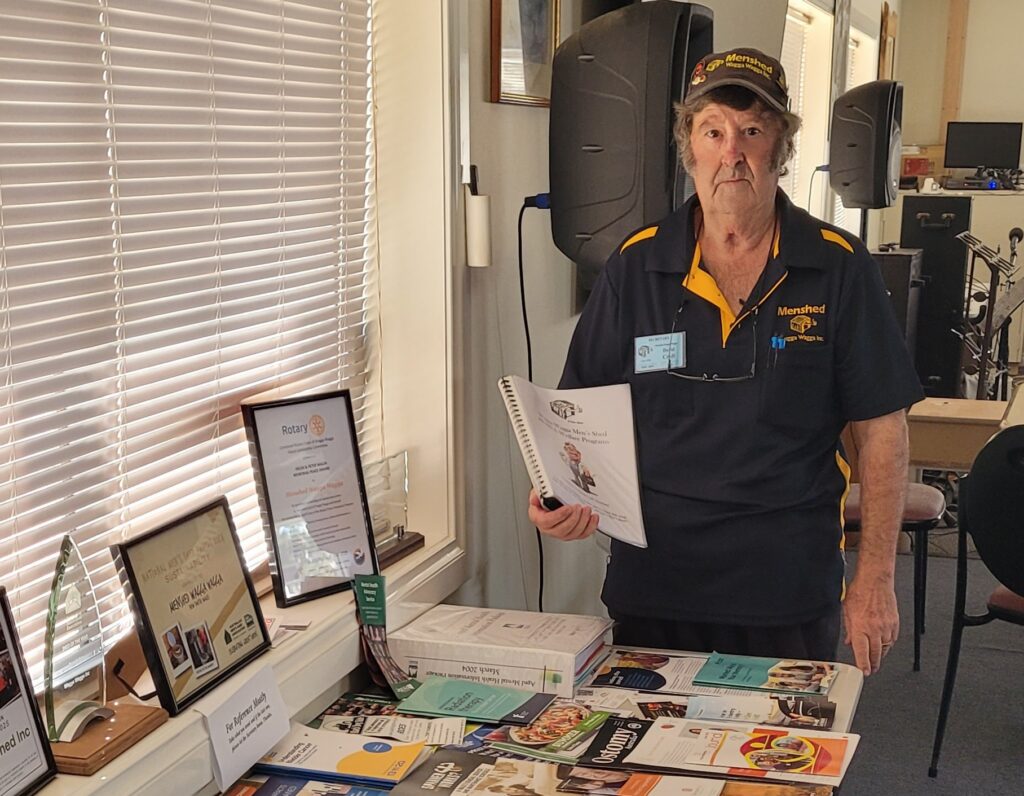
One of the things we’ve introduced is a Welfare Table where members can access brochures, information cards and resources from a range of health and community services.
Some men don’t like to ask for help directly, or they don’t know where to start. The Welfare Table gives them the opportunity to pick up information privately, take it home and look at it in their own time. There’s no pressure. The information is simply there when they need it.
What are some of the things you do to support the wellbeing of Shed members?
One of the most important things we do is host morning tea every day at 8:45am.
We can have around 50 members come together for a coffee, a snack and a chat. It’s something the blokes really look forward to and it gives everyone an opportunity to connect.
Personally, I’ve also had a lot of experience navigating different health issues and specialists over the years. When a member shares a concern with me, I can often point them in the right direction or encourage them to seek advice from a health professional.
Most things we can fix if we get onto them early enough.
We also have a partnership with Charles Sturt University, where medical students visit the Shed as part of their training. First-year students spend a day at the Shed learning about older men, while fourth-year students undertake placements with us.
It’s a fantastic opportunity for both the students and our members.
Have you noticed any positive changes in members as a result of wellbeing activities or conversations at the Shed?
Absolutely.
Morning tea is where a lot of it happens. The blokes might start by talking about the footy, current events or comparing ailments over a coffee, but those conversations build relationships and trust.
The involvement with the university students has also been really positive. It gives members the chance to discuss health topics, share their life experiences and interact with younger people in a meaningful way.
We have quite a few members in their late 80s and 90s, and the students love hearing their stories and learning from them.
What have you found works best when it comes to engaging blokes in wellbeing discussions?
Bringing people together and creating opportunities for conversation.
We regularly invite organisations such as Rotary, Probus, Dementia Australia and other community groups to come and talk about the services and programs they offer.
These presentations often spark discussions around some of the more challenging topics that men might not otherwise talk about.
One of the most powerful sessions we’ve held was with DonateLife.
The presentation focused on organ donation and the importance of registering your wishes. It was quite an emotional discussion, but it clearly resonated with our members.
After the session, 29 members joined the organ donor register. That showed us just how powerful these conversations can be.
The Welfare Table is another great conversation starter. Sometimes a member will pick up some information, take it away and come back later ready to talk.
The important thing is making sure they know the support and information is available.
What challenges do you face in the wellbeing role?
One challenge can be helping members understand and support others who may be dealing with health issues.
Sometimes people who have been fortunate enough to enjoy relatively good health don’t fully understand what others might be experiencing.
Education is important. The more we can build awareness and understanding, the more supportive and inclusive our Shed becomes.
Is there a particular wellbeing initiative that has been especially successful?
Without a doubt, our morning tea and our Welfare Table.
Neither is particularly complicated, but both create opportunities for connection, conversation and support.
Sometimes the simplest initiatives are the most effective.
What advice would you give to someone who has recently taken on the role of Wellbeing Leader?
Get to know the health services and practitioners in your local area.
Build relationships with GPs, dentists, podiatrists, pharmacists and other health professionals. Collect brochures and information that you can make available to members.
Your local pharmacist can often provide almost as much practical advice as your GP, so they’re a great contact to have.
Most importantly, ask the question: “How are things going?”
Sometimes you’ll get a general response. But sometimes someone is simply waiting for somebody to ask.
And when they do open up, remember this: “As a welfare officer, you don’t always need to give advice, just listen.”
If there was one thing you’d like every Shed to focus on when it comes to member wellbeing, what would it be?
The Men’s Shed motto says it best: Shoulder to shoulder – be there, listen, ask questions.
That’s what wellbeing is really about.
Is there anything else you’d like to share with fellow Wellbeing Leaders around the country?
One initiative that has worked really well for us is our member name badges.
On the front, they include the member’s name and the year they joined the Shed. On the back, they contain emergency contact information and any important medical details.Our local first responders know about the system and have told us how valuable it is in an emergency situation.
It’s a simple idea, but one that can make a real difference.
According to David, it all starts with a conversation.
David’s approach to wellbeing is refreshingly straightforward. It’s not about having all the answers or running complicated programs. It’s about creating a welcoming environment where men feel connected, supported and comfortable enough to talk when they need to.
Whether it’s over a morning coffee, through a casual check-in or by making health information easily accessible, the message is clear: Be there. Listen. Ask questions. And often that’s all it takes.
Are you a Wellbeing Leader? Sign up here for our monthly Wellbeing Watch newsletter.