

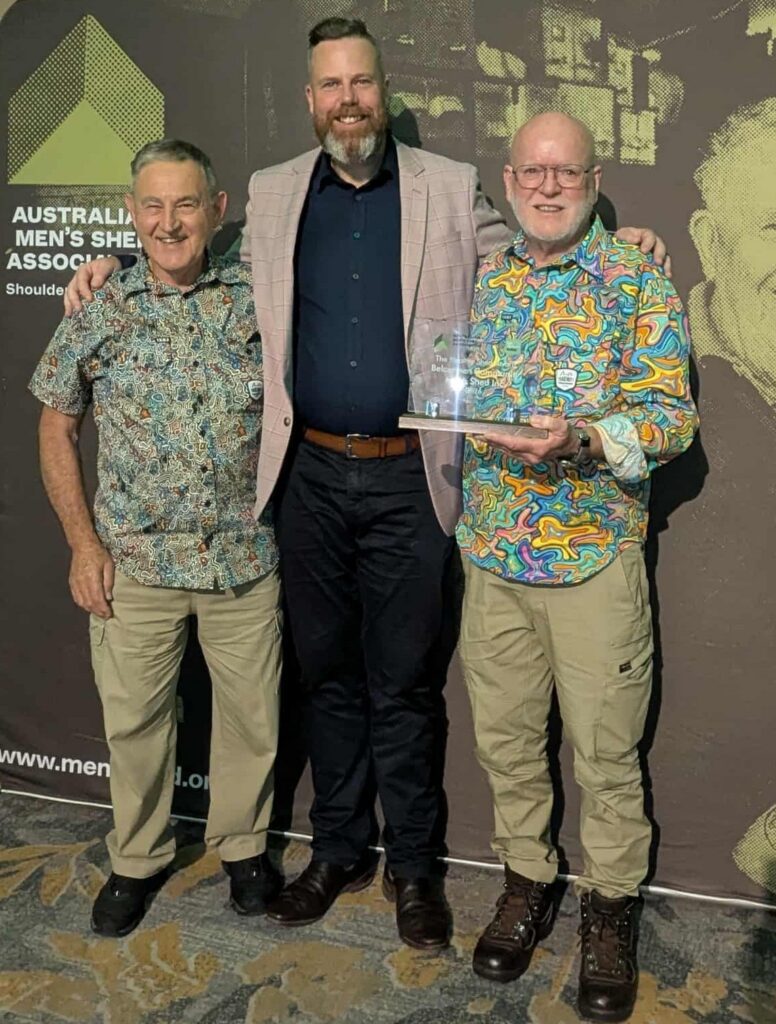
Dan Repacholi and Gordon Cooper
Interview: Gordon Cooper on the “Focused Blokes” Initiative
On the Pulse host Stuart Torrance speaks with Gordon Cooper, President of the Belconnen Community Men’s Shed (ACT), about their award-winning “Focused Blokes” program.
Stuart Torrance: Gordon, congratulations to the Belconnen Community Men’s Shed on winning the Healthy Shed, Healthy Blokes Award at the recent National Shed Gathering. You’re the President of the shed—how does it feel to receive this recognition?
Gordon Cooper: Thanks, Stuart. It’s important to say the shed won the award, not me. It’s been a whole-of-shed effort, and everyone has played a part in making it what it is.
Stuart: Your presentation at the gathering really stood out. Let’s talk about the initiative behind the award—Focused Blokes. How did it begin?
Gordon: It started about four to four-and-a-half years ago. I noticed more men in the shed going through tough times—mental health challenges, isolation, and personal struggles. After talking with other leaders and members, we realised we could do more to support them. I connected with a clinical psychologist, Louise Ramsey, who generously offered her time. She helped us shape what became Focused Blokes, particularly by guiding us in establishing our “ways of working,” which are now the backbone of the group.
Stuart: So while mental health is a key focus, it’s also about connection and reducing isolation. How does the group work in practice?
Gordon: We meet roughly every six weeks. Each session starts with a shared meal, which helps bring people together in a relaxed way. Often, we invite a guest speaker to share their story—whether it’s about mental health, work challenges, or life experiences. That helps open up conversation before we move into our group discussion.
Stuart: You mentioned the “ways of working.” What are some of the key principles that guide the group?
Gordon: A few stand out. We always begin with a check-in and end with a check-out—short at the start, but more open at the end if something has come up for someone. We listen with respect and don’t offer advice unless it’s asked for. And importantly, we allow silence. That can be uncomfortable at first, but it gives men the space to gather their thoughts and find the courage to speak.
Stuart: Silence can be difficult for people. How have the men adapted to that?
Gordon: It’s become part of the culture. Most men understand that during those quiet moments, someone is working up the courage to share something meaningful. Over time, it’s created a very safe and supportive environment.
Stuart: That’s quite a shift—from the workshop to a more personal, reflective space. What keeps men coming back?
Gordon: The sense of trust and connection. On average, we have about 11 men at each session, with around 20 regular participants over time. It’s a consistent group, and they support each other beyond the sessions. In fact, one member once said that everyone involved in Focused Blokes is effectively a wellbeing officer, because we all look out for one another.
Stuart: That idea really reflects the spirit of Men’s Sheds—looking out for your mates.
Gordon: Exactly. You notice when someone isn’t themselves. Sometimes it’s just a quiet word, a handshake, or even a hug. Not everything needs to be said out loud, but the support is there.
Stuart: It sounds like Focused Blokes is a strong community within the broader shed.
Gordon: It is. Our shed has around 140 members, and while only a portion attend Focused Blokes, they’re supported by the entire shed community. That sense of belonging is key. Men aren’t judged—they’re accepted and supported.
Stuart: The name Focused Blokes is interesting—where did it come from?
Gordon: During an early session, one of the men said we were there to focus on each other, not the shed activities. That stuck, and the name grew from that idea.
Stuart: You’ve also been involved in research around the program. Can you tell us more about that?
Gordon: Yes, we’ve partnered with ANU, along with Louise Ramsey and a medical student, to survey our shed. While the results aren’t published yet, early findings show that Focused Blokes is making a significant difference. We hope this evidence will help demonstrate the value of Men’s Sheds and support the case for ongoing mental health funding.
Stuart: That kind of evidence is so important. We hear many stories about the impact of sheds, but documenting it helps strengthen the case for support.
Gordon: Absolutely. We know sheds save lives—we see it firsthand. Research helps us show that more broadly.
Stuart: Finally, if other sheds are interested in starting something similar, are you open to sharing your experience?
Gordon: Definitely. I’m happy to be contacted and even travel to help set up a group or run an initial session. It’s a simple idea, but it meets a deep need. You don’t need to be a professional—just someone willing to listen and show empathy.
Stuart: Gordon, thank you for sharing your insights, and congratulations again to the Belconnen Community Men’s Shed on this well-deserved award.