Purpose isn’t something you find. It’s something you build.
Every day, across Australia, Men’s Sheds are building friendships, sharing skills, supporting communities and creating places where people belong.
Because every Shed is Built on Purpose. This Men’s Shed Week we’re launching our first National Impact Snapshot to demonstrate the ripple effect starting in Men’s Sheds and continuing into communities across the country.
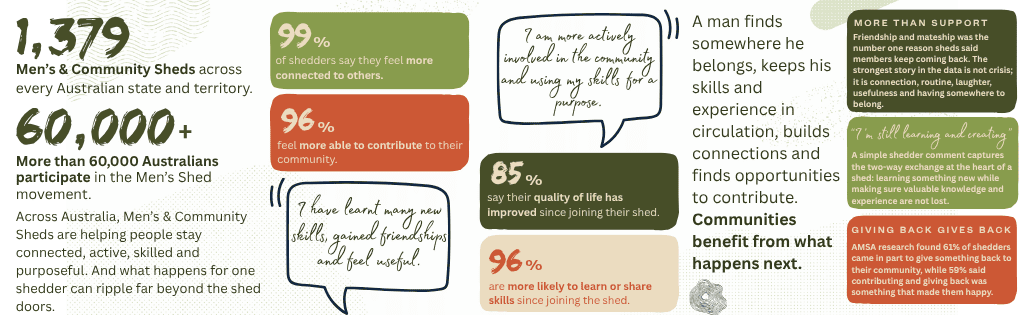
Recent research undertaken by AMSA found 84.5% of shedders surveyed said their quality of life had improved since joining their shed. Among those answering questions about their experience since joining, 98.8% said they felt more connected to others, 95.5% said they were more likely to learn or share skills, and 96.2% felt more able to contribute to their community.
Behind those numbers is a simple story. A man finds somewhere he belongs, meets people, keeps his skills and experience in circulation and often learns something new along the way. In time, what he gains from the shed becomes something he can give back to another member, a young person, a local organisation or the wider community.
AMSA Executive Officer David Helmers said the findings demonstrate why the impact of Men’s Sheds cannot be measured simply by what happens inside the shed.
“The story of Men’s Sheds has always started with the men, but it doesn’t end there. When a man finds mateship, purpose and a place where his skills are valued, that benefit flows through the shed and into the community around him.”
“Men’s Sheds aren’t only places where men receive support. They are places where men participate and contribute, sharing skills, mentoring others, volunteering their time and putting their experience to work in ways that strengthen their communities.”
This year’s Men’s Shed Week theme, Built on Purpose, explores that impact through four interconnected ideas — Belong, Create, Connect and Contribute — reflecting both what men gain from being part of a shed and what they give in return.
The research shows that friendship and connection remain central to the experience, but they are only part of the story. Men’s Sheds also provide opportunities for members to keep their skills and knowledge active, learn from one another, take on new challenges and use their experience in ways that continue to have value.
Across the sheds participating in the 2026 National Impact Snapshot, 86% reported members teaching skills to one another, 84% had members learning new skills and 78% were mentoring new members.
And that sharing goes both ways. Members keep learning, while decades of practical knowledge and experience are passed on rather than lost. Those skills then travel beyond the shed through community projects, volunteering, mentoring and the everyday jobs sheds take on for others.
Importantly, contribution appears to be part of what men themselves value about belonging to a shed. Earlier AMSA research found 61% of shedders came in part to give something back to their community, while 59% said contributing and giving back was something that made them happy.
The scale of that contribution becomes particularly clear when the experiences of individual shedders are considered alongside the collective work of their sheds.
Sometimes it is a small repair for someone who needs a hand, making something for a school, mentoring a young person, supporting a community event or putting hundreds of volunteer hours into a local project. Added together, those everyday acts represent an enormous contribution.
The 234 Men’s Sheds participating in AMSA’s 2026 National Impact Snapshot, representing more than 12,000 active members, collectively reported more than 200,000 volunteer hours and more than 3,300 community projects and activities in the past year. More than 2,000 community organisations and groups benefited from the work reported by participating sheds.
Those relationships extend throughout local communities, including schools and preschools, aged care facilities, disability organisations, sporting clubs, veterans groups, councils, environmental projects, emergency services and community events.