Marty Leist
If you ever go to Beechworth in North-East Victoria, I would suggest you go around Autumn. Well, that’s when I visited anyway. Beechworth is famous for its growth during the 1850’s gold rush days… but the only real gold you’ll find there now is in the blanket of Autumn leaves mixed with the rich reds and vibrant oranges from the Elms and Oaks that line the streets (and, of course, in the people).
You could take a snapshot from just about anywhere you stood, and it would make a perfect postcard with the backdrop of heritage style buildings that host the chic boutique stores catering to a strong flow of tourists. And if you tire of the wine tasting you could spend a good hour tasting the myriad of flavours at the Beechworth Honey storefront on the main street. Winne the Pooh would be in heaven!
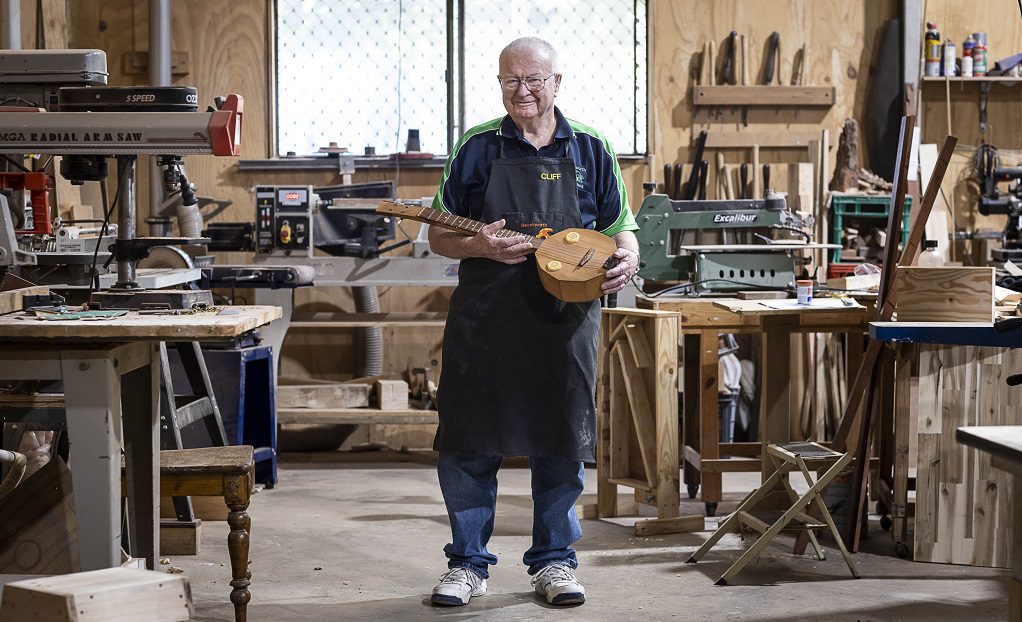
Like most Australian towns these days, Beechworth is home to a Men’s Shed. A good one, dare I say, a great one! Nestled discreetly behind the Beechwood Health Service facility, the shed is not only neat, tidy and well set up to keep the riff raff off the street, it’s a cosy respite for many of the members, including long time member Cliff “Cliffy” Cousins.
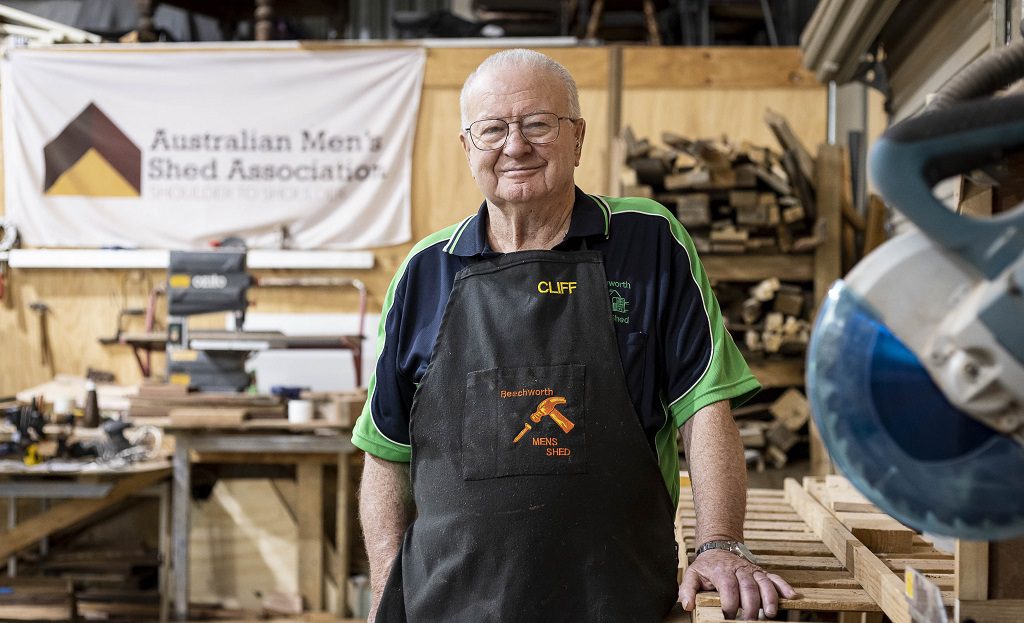
An ex-farmer, born and bred in Gapsted (about 20km out of Beechworth), Cliff has been going to the shed for about 10 years, mixing it with the gents and doing his share including taking on the role of Shed Coordinator for a few years.
I spoke to Cliff via video call. I wanted to interview ‘someone who had a bit of a story’ as I proposed it to the Shed President, Smithy. And he said, “Cliffy is your man.”
Cliff first joined the Beechworth Men’s Shed when his wife was at the worst of her illness and he needed an outlet. He said he had heard about the shed from a couple of ‘old blokes’ talking in the street. He’s a full blown ‘Shedder’ now.
Prior to receiving his Shedder title, Cliff was a farmer, just like his father. In fact, Cliff and his wife Elaine were both farmers (as from all accounts she tended to get her hands dirty as much as he did), and they made for a great team.
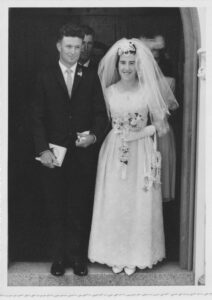 Cliff and Elaine first grew tobacco on share farms at Gapsted and Myrtleford. That was back before it was all imported. Cliff told me they were profitable years but they were big days: 4:00am until 10:00pm at night, for seven to eight months of the year. First thing in the morning Cliff and Elaine would get up and steam the kiln, stack it, and then get out to start picking again.
At 1:30pm they stopped for a bit of lunch, then they would tie the tobacco up and put it in the kiln again. Eat, sleep, repeat.
Tobacco grows quite quickly. As Cliff told me, “We would plant in October/November and were picking by early January.”
The tobacco was sold at auction to big multinationals like Phillip Morris. Cliff said it was good money in those days, “It was hard work for a while, but it set us up. We also had a lease property and ran a few cows, but tobacco was the main income.”
When land was selling well, Cliff and Elaine bought 20 acres in Bunbartha and ran pigs and dairy for about 18 years, until they finally bought 262 acres in Arcadia South and started dry land farming. They cropped about 200 acres and grew mostly Triticale and Oats.
Elaine was never a silent partner. Cliff would often go out and do a bit of orchard work on the side during the summer (because that’s what you do when you can only fill 98.5 per cent of your days), and if he wasn’t able to be on the farm in Autumn when it was time to plant the crops, Elaine would do it. And even when they had the pigs Cliff recalled fondly with admiration, “If the truck came to put the pig feet in the silo, she’d have no problem climbing up the ladder to the top to open it up so they could blow the feed in.”
All this as well as ‘flipping’ three properties on the side, and two children on the side, kept them both pretty busy.
Cliff loved farming. It was a good life, but there were some tough years. “2000 to 2004 were very tough but we got by,” said Cliff.
“In the year 2000, we didn’t get a thing. We couldn’t fill the grain from the crops. We could grow straw but it just wouldn’t make grain so we used to bail it and sold it to dairy farmers as they couldn’t grow enough of their own feed. That’s how we got by.”
In 2008 Cliff and Elaine retired, sold up the farm and moved to Beechworth. Elaine’s history of diabetes had caused kidney problems and then later failure and she wanted to spend her final years closer to town. Cliff became Elaine’s full time carer.
For anyone who has never been involved in the process, kidney dialysis is a grueling experience that takes time and effort. For the patient it involves being hooked up to the dialysis machine for about four hours, three to four days a week. For the nurse or caregiver, it’s an exhausting procedure of needles, machine maintenance and maintaining the comfort of the patient.
Elaine wasn’t much on hospitals so Cliff decided that he would do this from home and dialysed Elaine every second night for the next 11 years. He described it as “a big job”. Blokes like Cliff are prone to understatement.
As if that doesn’t sound challenging enough, Cliff didn’t want this to define the final years of his and Elaine’s adventure through life together, so he packed the dialysis machine up in the caravan and hit the road. They managed to see the best part of New South Wales, and a little of South Australia too. Wow, just wow.
Unfortunately for Cliff and Elaine, the hits didn’t stop with kidney failure. Elaine was diagnosed with ovarian cancer. With the prospect of more time spent in and out of hospital, Elaine withdrew from all treatments so she didn’t have to suffer from the cancer and lengthen the process. A brave and selfless decision.
Cliff cared for Elaine throughout her illness until she passed away in 2013 at 71. Cliff said his mates at the Beechworth Men’s Shed played an integral part of supporting him through this period, and again recently when he tragically lost his son Doug, to Covid.
Yeah, you read it right, covid. At 54 years old Doug was as fit as a fiddle and just six weeks shy of meeting his first grandchild. Doug suffered from long Covid for about six months but had been improving so the sudden loss was a real shock for Cliff and his family.
Cliff has had some health issues of his own of late, but now he’s equipped with a fancy new valve in his heart and a pacemaker so he’s just about ready to get back to work at the shed.
The fellas say he’s a pretty clever woodworker but one his favourite things is working with the kids from the local school. Some of the ‘troubled’ kids he calls them, from year five and six.
“They seem to be more interested than the older kids that tend to just want to be on their phones,” he tells me.
“There was one lad who wanted to build a cupboard, so I used to open up on a Saturday morning for him to come in. He loved it so much it became a bit of a job getting him to go home. I really like working with those kinds of kids,” Cliff tells me with a look you could describe as grateful contentment.
“There was one lad who wanted to build a cupboard, so I used to open up on a Saturday morning for him to come in. He loved it so much it became a bit of a job getting him to go home. I really like working with those kinds of kids,” Cliff tells me with a look you could describe as grateful contentment.
Cliff is 80 years old now. At home he still has a few tools and says his next project is building a larger cage for his canary with the thought that maybe he’ll breed them.
Cliff’s daughter lives nearby in Lavington and he often gets visits from his five grandchildren and nine great grandchildren often visit, “so that’s nice,” says Cliff.
“But it’s also nice to wave them goodbye… They can be a bit loud at times.”
Cliff is a very humble and unassuming man that tends not to give much away, so I had to dig a bit and ask his shed mates for information.
“Tell him about your cricket Cliffy,” I hear from Smithy in the background.
Apparently Cliff was a gun cricketer in his day. He Captained the Bunbartha B-Grade side all the way to the grand final, undefeated. And then lost it. “The wheels totally fell off,” he said.
Cliff was described to me (by Smithy) as a “stalwart of the Shed. Even tempered, not one of them flamboyant or boisterous ones, but a quiet achiever. But a bit of a hoarder too.”
Cliff goes down to the shed three days a week (that’s pretty much every day it’s open) and that’s good. His mates are there, and they love him and I’m sure he is just as endeared by them (although neither would ever let on).
It’s a special kind of language at the shed, more actions than words, and a simple gesture like a hand on your shoulder can speak volumes and mean the world.
It’s a special kind of language at the shed, more actions than words, and a simple gesture like a hand on your shoulder can speak volumes and mean the world.
Cliff has some great mates at the shed and, with his refurbished ‘ticker,’ the shed will have Cliffy for a long while yet too.